

Comparing Windows 12 to Windows 11 sounds straightforward until you realize one side of that comparison doesn’t officially exist. There’s no released Windows 12, no confirmed feature list, and no confirmed date. What we can do honestly is lay Windows 11’s actual, confirmed capabilities next to the credible, sourced speculation about where a next-generation release would plausibly go, and be upfront about which side of that line each item falls on.
That’s what this page does, without inflating rumor into certainty just to make the comparison feel more complete.
The comparison, side by side

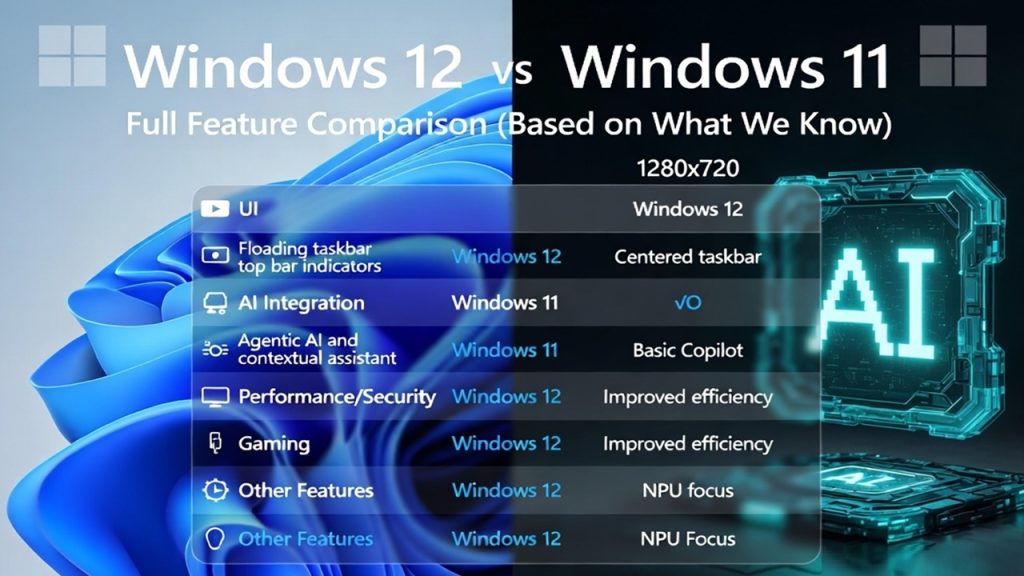
| Category | Windows 11 (confirmed, today) | Windows 12 (rumored or plausible direction) |
|---|---|---|
| Release status | Available now, current version 25H2 | Not announced, no confirmed date |
| AI integration | Copilot across search, settings, files; Copilot+ PC tier with on-device features | Speculated deeper, more agentic Copilot; direction unconfirmed |
| NPU requirement | 40 TOPS minimum for Copilot+ certification; not required for base OS | Possibly integrated more broadly; no confirmed figures |
| Architecture | Traditional monolithic Windows architecture | Modular “CorePC” concept discussed for years, never shipped publicly |
| Base requirements | TPM 2.0, Secure Boot, 4GB RAM, 64GB storage | Likely similar or stricter; unconfirmed |
| Interface | Ongoing refinements to File Explorer, taskbar, Settings | Concept art suggests further evolution; not confirmed by Microsoft |
| Support timeline | 25H2 supported through October 2027 | N/A, no release exists |
The left column is fact. The right column is a mix of credible industry speculation and outright unconfirmed guesswork, and treating every row the same way would be misleading. Here’s the honest breakdown of each area.
AI and Copilot: what’s real versus what’s speculated
Windows 11’s Copilot integration is genuinely substantial today, spanning search, file handling, and system settings, and Microsoft’s Copilot+ PC tier already delivers real on-device features like Recall, live translated captions, and Cocreator image generation on qualifying hardware. This isn’t a preview of something coming, it’s shipping now.
What’s speculated for a next-generation release is a shift toward a more persistent, agentic Copilot, one that can act across the OS on your behalf rather than waiting to be asked. This direction is plausible given Microsoft’s public statements about wanting AI “at every layer” of the OS, but the specific scope, timeline, and whether it would even carry a “Windows 12” name are all unconfirmed. We go much deeper into exactly what’s shipping today versus what’s genuinely just direction in our dedicated breakdown, Windows 12 AI Features: What Copilot+ Already Tells Us.
Architecture: the CorePC question
One of the most persistent Windows 12 rumors involves a modular system architecture, sometimes called CorePC, that would separate Windows into isolated components for more flexible updates and resets. This concept has real history, tracing back to the shelved Windows Core OS and Windows 10X projects, and it resurfaces periodically in leaks and internal references.
Despite that history, CorePC has never shipped in a public release, and there’s no current evidence it’s part of Microsoft’s near-term roadmap. Windows 11 today runs on a traditional, monolithic architecture, the same general structure it’s always used. If a next-generation release does adopt a modular approach, it would represent a genuine architectural shift, but there’s nothing confirmed pointing to when, or if, that happens. Our full breakdown of this and other rumored features, sorted into confirmed, credible, and debunked categories, is available in Windows 12 Features: What’s Rumored, Confirmed, and Already in Windows 11.
System requirements: what’s confirmed versus predicted
Windows 11’s actual requirements (64-bit processor, TPM 2.0, Secure Boot, 4GB RAM, 64GB storage) are fixed and documented. Predicting Windows 12’s requirements means extrapolating from that baseline plus the existing Copilot+ tier, not reading a leaked spec sheet, because no such document exists. The most defensible prediction is that requirements tighten further rather than loosen, and that NPU support becomes more standard rather than remaining a separate premium tier, but treating any specific number as confirmed would be inaccurate. We’ve laid out the full reasoning, including which specific numbers circulating online are unconfirmed guesses, in Windows 12 System Requirements: What We Can Predict from Windows 11.
Interface and design: concept art isn’t confirmation
A lot of visual “Windows 12 vs Windows 11” comparisons circulating online use fan-made concept renders as if they represent Microsoft’s actual design direction. Nearly all of the polished “leaked interface” images you’ve seen are independent concept work, not screenshots from a real Microsoft build. Confirmed interface direction, based on actual recent Windows 11 updates, points toward continued refinement of File Explorer, taskbar behavior, and Settings, generally trending more AI-contextual rather than a dramatic visual overhaul. For a full breakdown of how to tell real leaks from concept art, including specific examples, see Windows 12 Concept Designs: Real Renders vs Actual Leaks.
Is Windows 11 26H1 actually part of this comparison?
Worth addressing directly, since it comes up constantly: Windows 11 version 26H1 is not Windows 12 under a different name. It’s a scoped feature update for new devices launching in early 2026, using Microsoft’s existing year-and-half naming convention, not a version-number jump to a new OS generation. We cover this specific confusion in detail in Windows 12 vs Windows 11 26H1: Is This Actually the Same Thing?, since it’s a genuinely common point of confusion distinct from the broader Windows 12 vs Windows 11 comparison this page covers.
Should you wait for Windows 12, or use Windows 11 now?
Given there’s no confirmed release date, and Microsoft has directly stated near-term announcements don’t include a new OS version, waiting indefinitely isn’t a practical strategy for most people. Windows 11 25H2 is a mature, actively supported platform with a support runway through October 2027, and a meaningful share of what people are actually hoping “Windows 12” will bring (AI integration, on-device processing, interface refinements) is already available today through the Copilot+ PC tier.
If you’re specifically trying to decide whether to buy new hardware now or hold off, the practical middle ground is choosing hardware that already meets or exceeds the Copilot+ PC tier, since that positions you reasonably well regardless of exactly when or whether a next-generation release arrives. For the current, continuously updated status of whether that release is getting any closer, check our Windows 12 release date and status tracker.
What would actually make this comparison “complete”
To be fully transparent about the limits here: a genuinely complete Windows 12 vs Windows 11 comparison isn’t possible yet, because one side of it doesn’t exist as a real product. What this page offers instead is the most accurate picture available today, clearly separating confirmed Windows 11 capability from credible industry direction and outright debunked claims, rather than pretending unreleased software has a settled spec sheet. If you’ve seen a competing comparison stating specific Windows 12 features or requirements as fact, it’s worth checking whether it’s actually sourced from a Microsoft statement or a verifiable Insider build, or whether it’s simply repeating unconfirmed claims with more confidence than the evidence supports. Our guide to fact-checking Windows 12 rumors walks through exactly how to make that call yourself.
A handful of questions worth clearing up
Is Windows 12 confirmed to exist? No. Microsoft has not announced Windows 12 as a product, and has directly stated that near-term plans don’t include a new OS version.
What’s the single biggest difference between Windows 11 and rumored Windows 12? Based on current direction, it would likely be architecture (a possible shift toward modular components) and deeper AI integration, though neither is confirmed.
Are Windows 12’s AI features already available? Many of the AI capabilities people associate with Windows 12 are already shipping in Windows 11 through the Copilot+ PC tier, including Recall, live translated captions, and on-device image generation.
Should I upgrade my hardware now for Windows 12? Only if you have a genuine reason to upgrade anyway. Choosing hardware that meets the current Copilot+ PC tier is a reasonable hedge, but there’s no confirmed timeline creating urgency.