Apple used its WWDC 2026 keynote in June to introduce Siri AI, a ground-up rebuild of Siri sitting on top of a new generation of Apple Intelligence. It’s a notably more ambitious pitch than Apple’s original Apple Intelligence rollout, which drew real criticism for underdelivering on similarly bold promises. Here’s exactly what was announced, how it’s built, and how it genuinely compares to what Microsoft already ships today through Copilot+.
What Apple actually announced
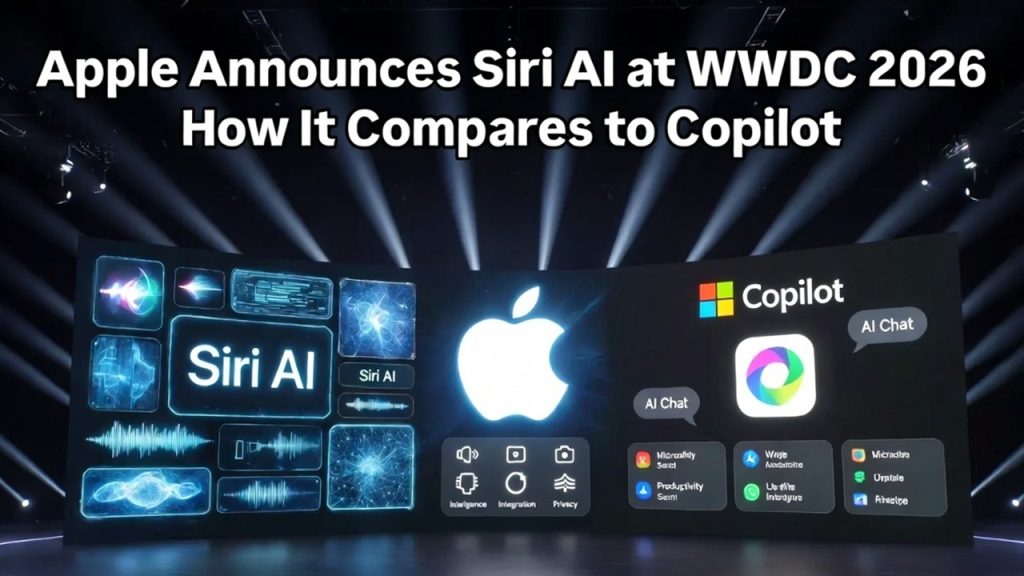
Siri AI moves well beyond the command-and-response assistant Siri has historically been, toward multi-turn conversation, contextual awareness across a user’s Messages, Mail, and Photos, and the ability to take actions inside apps rather than simply answering questions. On Mac specifically, it’s built directly into Spotlight, accessed with Command-Space, and into right-click context menus system-wide, alongside a dedicated standalone Siri app that syncs conversation history across a user’s devices through iCloud.
Apple’s underlying architecture splits processing between on-device models, which the company calls Apple Foundation Models, and cloud-based processing through what it calls Private Cloud Compute, a system designed so that sensitive tasks stay local while more demanding requests get handled remotely without, according to Apple, exposing personal data during that process. Reporting following the announcement has also noted that Google’s Gemini technology reportedly contributes to part of the underlying model layer, which is a notable detail for anyone assuming this is an entirely in-house Apple system.
The rollout timeline
Siri AI entered developer beta immediately following the WWDC 2026 announcement, with a public beta scheduled for July 2026 and a full consumer release planned for fall 2026, arriving alongside macOS 27. This staged rollout matters for anyone comparing it directly against Microsoft’s Copilot+ features, since Copilot+ is a shipping, available product today, while Siri AI, as of this announcement, remains a beta-stage rollout with a firm but future ship date.
Hardware requirements: not universally available on day one
As with most major AI feature rollouts, Siri AI isn’t uniformly available across all Apple hardware. Its most advanced on-device capabilities specifically require an M3 Mac or later with at least 12GB of unified memory, and certain individual features, including an improved Siri voice and expanded system-wide dictation, need even newer silicon specifically. This mirrors Microsoft’s own approach with Copilot+, where the most advanced features are gated behind a specific NPU performance threshold (40 TOPS minimum) rather than made universally available across all existing Windows 11 hardware.
How Siri AI actually compares to Copilot+ today
This is where it’s worth being precise rather than declaring an easy winner, since the two products currently sit at genuinely different stages of maturity.
Availability. Microsoft’s Copilot+ features, Recall, live translated captions, Cocreator image generation, Windows Studio Effects, Click-to-Do, are shipping today on qualifying hardware. Siri AI is in developer beta as of this announcement, with public availability still months away. If you’re comparing based on what you can actually use right now, Copilot+ is currently ahead simply by being real and available.
Ambition. Siri AI’s stated scope, cross-app contextual awareness and the ability to take multi-step actions on a user’s behalf, is closer to the “agentic assistant” direction that’s also been speculated for a future Windows release, arguably more explicitly stated by Apple than anything Microsoft has confirmed publicly for Copilot’s own roadmap. If Apple’s execution matches its keynote demonstrations, it would represent a more mature version of exactly the direction Microsoft has said it wants to eventually take Copilot.
Privacy framing. Both companies are using nearly identical talking points here. Microsoft ties Recall and other on-device Copilot+ features to local encrypted storage and Windows Hello authentication. Apple frames Siri AI around on-device Foundation Models plus Private Cloud Compute specifically designed to avoid retaining personal data. Neither approach is independently auditable by an average consumer, so both ultimately come down to trusting each company’s stated implementation.
Hardware gating. Both platforms reserve their most advanced capabilities for newer hardware rather than making everything universally available, Microsoft through the Copilot+ NPU tier, Apple through the M3-and-newer requirement for Siri AI’s deepest features.
Why this announcement matters for Windows 12 speculation specifically
Apple’s Siri AI announcement effectively raises the competitive bar for whatever comes after Windows 11, whenever that actually arrives. Multi-turn conversation, deep cross-app context, and real task execution are quickly becoming baseline expectations across both major desktop platforms rather than differentiators either company can claim exclusively. Given that Microsoft has already signaled wanting AI at “every layer” of the OS, it’s a reasonable expectation that any next-generation Windows release pushes meaningfully further than what Copilot+ already delivers today, simply to remain competitive with where Apple has now publicly committed to going. We cover this full comparison, including a detailed feature table, in Windows 12 vs macOS: What Rumored AI Features Would Actually Change.
Regional and language limitations worth knowing
Siri AI’s initial rollout carries real limitations if you’re specifically timing a purchase or upgrade decision around it. It launches in English first, isn’t available initially in China, and has restricted availability across some EU markets depending on the specific device and OS version. This is a meaningfully more staggered rollout than Microsoft’s Copilot+ features, which are tied primarily to hardware qualification rather than region-and-language sequencing, though pricing and specific hardware availability still vary by market on the Windows side too.
What Apple’s history with Apple Intelligence suggests about managing expectations here
It’s worth being clear-eyed about one thing: Apple’s original Apple Intelligence rollout, announced with similarly ambitious framing, drew genuine criticism for delayed features and underwhelming real-world performance relative to its keynote demonstrations. Siri AI’s announcement deserves the same measured skepticism until its public beta and full release actually demonstrate whether Apple has closed that execution gap this time. Announced ambition and delivered product are two different things, and Apple’s own recent track record is the most relevant evidence for how much to weight the keynote promises versus the eventual shipping reality.
What this means if you’re deciding what to buy right now
If you need AI-assisted features today, specifically things like on-device translation, image generation, or video call enhancements, Windows 11’s Copilot+ tier is the more immediately available option, provided your hardware or a new purchase meets the NPU requirement. If you’re specifically invested in the Apple ecosystem and willing to wait through a beta cycle, Siri AI’s fall 2026 release is worth watching closely, though its final real-world performance remains genuinely unproven as of this announcement.
For the current, regularly updated status of whether a next-generation Windows release might respond to this competitive pressure, see our Windows 12 release date and status tracker, and for the fuller breakdown of what’s actually shipping in Windows 11 today, see Windows 12 AI Features: What Copilot+ Already Tells Us.
Frequently asked questions
Is Siri AI available to use right now? It’s in developer beta as of the WWDC 2026 announcement, with a public beta arriving in July 2026 and a full consumer release planned for fall 2026 alongside macOS 27.
What Mac do I need for Siri AI’s full features? An M3 Mac or later with at least 12GB of unified memory for the most advanced on-device capabilities, with some individual features requiring even newer silicon specifically.
Does Siri AI use Google’s technology? Reporting following the announcement has noted that Google’s Gemini technology reportedly powers part of the underlying model layer, alongside Apple’s own Foundation Models.
Is Copilot+ more advanced than Siri AI right now? In terms of what’s actually shipping and usable today, yes. Siri AI’s more ambitious capabilities remain in beta as of this announcement, while Copilot+ features are already available on qualifying Windows 11 hardware.
Will this pressure Microsoft to accelerate a next-generation Windows release? There’s no direct evidence of that yet, but Apple’s more ambitious announced roadmap does raise the competitive bar for whatever Microsoft eventually ships next, whether under the Windows 11 umbrella or a future release.