Microsoft has directly addressed months of building speculation that it would unveil Windows 12 at its Build 2026 developer conference, confirming that upcoming announcements do not include a new operating system version. The statement came from Pavan Davuluri, who currently leads both the Windows and Surface divisions at Microsoft, and it’s about as clear a signal as the company has given on this question in recent memory.
What actually happened
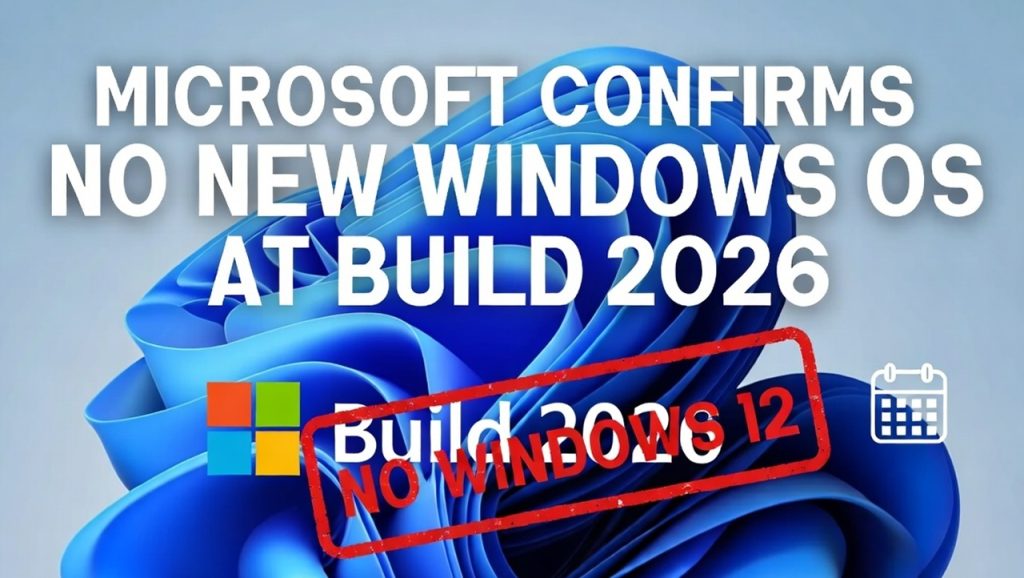
In the days leading up to Build 2026, a wave of tech coverage anticipated a major Windows announcement, fueled largely by a coordinated social media tease. Microsoft’s official Windows account, alongside NVIDIA and Arm’s own accounts, posted variations of the phrase “a new era of PC” around the same time, with MediaTek’s account following shortly after. Given the ongoing, years-long search demand and speculation around “Windows 12,” a lot of outlets connected those dots to an imminent OS reveal.
Davuluri stepped in to correct that expectation before it snowballed further, stating plainly that the company’s upcoming announcements would not include a new operating system version. The actual substance behind the teaser turned out to be hardware and silicon news rather than software: specifically, NVIDIA CEO Jensen Huang’s keynote at Computex in Taipei, and an Arm-based chip project, reportedly codenamed N1X, being developed in partnership with MediaTek.
In short, the “new era of PC” messaging was about new hardware categories, not a new version of Windows.
Why this statement carries real weight
Windows 12 speculation isn’t new, but it’s rarely been addressed this directly by someone in Davuluri’s specific position. He’s the executive currently overseeing both Windows and Surface at Microsoft, meaning this isn’t a spokesperson deflecting a question, it’s a direct statement from the person actually responsible for the roadmap being asked about.
That distinction matters for how much weight to put on it. A lot of the Windows 12 content circulating before this statement leaned on unnamed sources, internal roadmap leaks, or extrapolation from Microsoft’s historical release cadence. This is Microsoft’s own current Windows leadership addressing the question head-on, on the record, tied to a specific, named event.
How this fits into the broader Windows 12 timeline
This isn’t the first time Windows 12 speculation has run ahead of anything Microsoft has actually confirmed, and it likely won’t be the last. But it is a useful anchor point for anyone trying to track this story accurately, since it directly contradicts a specific, concrete claim (an imminent Build 2026 reveal) that had gained real traction beforehand.
Zooming out, the broader picture Davuluri’s statement reinforces is one that’s been building for a while: Microsoft’s public actions throughout 2025 and into 2026 have consistently pointed toward continued investment in Windows 11 rather than a rush to a new version. Windows 11 has continued receiving substantive feature updates (25H2, and the scoped 26H1 release for new devices launching in early 2026), and Microsoft has steadily folded AI capabilities into the existing platform through the Copilot+ PC program rather than holding them back for a future release. We cover this pattern in detail in Windows 12 Features: What’s Rumored, Confirmed, and Already in Windows 11.
What Build 2026 actually delivered instead
With the OS-reveal expectation cleared out of the way, Build 2026’s actual focus centered on hardware and AI infrastructure rather than a new Windows version. The NVIDIA and Arm partnership news, tied to Huang’s Computex keynote, centered on next-generation silicon aimed at expanding the PC hardware ecosystem, particularly around Arm-based computing, an area Microsoft has been pushing for several years with mixed but improving results on the Windows side.
This aligns with a broader theme across the industry in 2026, where AI-capable hardware (NPUs, on-device processing, Arm-based efficiency gains) has become the primary battleground between Microsoft, Apple, Qualcomm, and others, more so than headline OS version numbers. We explore this exact dynamic, including how Apple’s own recent Siri AI announcement stacks up, in Windows 12 vs macOS: What Rumored AI Features Would Actually Change.
Why the “new era of PC” phrase misled so many people
It’s worth examining specifically why this particular tease created so much confusion, since it’s a pattern likely to repeat with future Microsoft announcements. Multiple official accounts (Microsoft’s own Windows account, NVIDIA’s, Arm’s, later MediaTek’s) posting similar, deliberately vague language in a coordinated window created an impression of a singular, unified announcement, when the reality was several separate companies each teasing their own distinct piece of hardware news that happened to be scheduled around the same event.
Combined with years of pent-up “when is Windows 12 coming” search demand, that ambiguity was almost guaranteed to get filled in with the explanation people were already primed to expect. This is a useful lesson for evaluating future Microsoft teasers too: vague, evocative marketing language shared across multiple corporate accounts doesn’t necessarily point to what search demand assumes it points to, especially around a topic with as much standing speculation as Windows 12.
What credible industry reaction looked like afterward
Coverage following Davuluri’s statement generally settled into a more grounded, if less exciting, narrative: Microsoft’s near-term roadmap is Windows 11 refinement and AI expansion, not a new numbered release. Some outlets have continued floating a 2027 window for any genuinely next-generation Windows release, reasoning from Microsoft’s historical six-year cadence between major versions (Windows 10 launched in 2015, Windows 11 in 2021), though this remains an estimate rather than anything Microsoft has confirmed.
For the fullest, continuously updated breakdown of where the release timeline actually stands following this statement, see our Windows 12 release date and status tracker.
Does this mean Windows 12 is cancelled?
Not necessarily, and it’s worth being precise about what was and wasn’t said. Davuluri’s statement addressed near-term plans specifically, tied to the Build 2026 announcement window. It didn’t rule out a future release entirely, and given that “Windows 12” has surfaced in internal roadmap references and reporting for years, it’s reasonable to assume Microsoft is still thinking about a next-generation release long-term, just not on the timeline a lot of pre-Build 2026 speculation assumed. We break down exactly what is and isn’t confirmed about Windows 12’s existence at all in Is Windows 12 Real? Fact-Checking the Rumors.
What this means if you were waiting on this announcement specifically
If you were holding off on a hardware purchase or an OS upgrade specifically because you expected a Windows 12 reveal at Build 2026, that expectation has now been directly addressed and shouldn’t factor into your planning going forward. The practical guidance remains the same as it was before Build 2026’s hype cycle began: Windows 11 is the current, actively supported platform, with a support runway extending well into 2027 for its 25H2 release, and there’s no confirmed reason to delay an otherwise sensible upgrade decision on the hope of an unconfirmed future product.
Common questions about this announcement
Who confirmed there’s no new Windows version coming? Pavan Davuluri, who leads both the Windows and Surface divisions at Microsoft, addressed the speculation directly ahead of Build 2026.
Why did people expect a Windows 12 announcement at Build 2026? Microsoft’s Windows account, along with NVIDIA and Arm, posted “a new era of PC” teaser language ahead of the event, which a lot of coverage interpreted as pointing toward a new OS reveal. The actual news turned out to be hardware and silicon related instead.
What was actually announced at Build 2026 if not Windows 12? Hardware and AI infrastructure news, including NVIDIA’s Jensen Huang covering developments tied to his Computex keynote, and an Arm-based silicon project developed with MediaTek.
Does this rule out Windows 12 happening eventually? Not definitively. It specifically addresses near-term plans. Longer-term, most credible speculation now points toward 2027 at the earliest, based on Microsoft’s historical release cadence, though nothing is officially confirmed.
Where can I follow the most current status on this? Our Windows 12 release date and status tracker is updated directly whenever Microsoft’s public position changes.