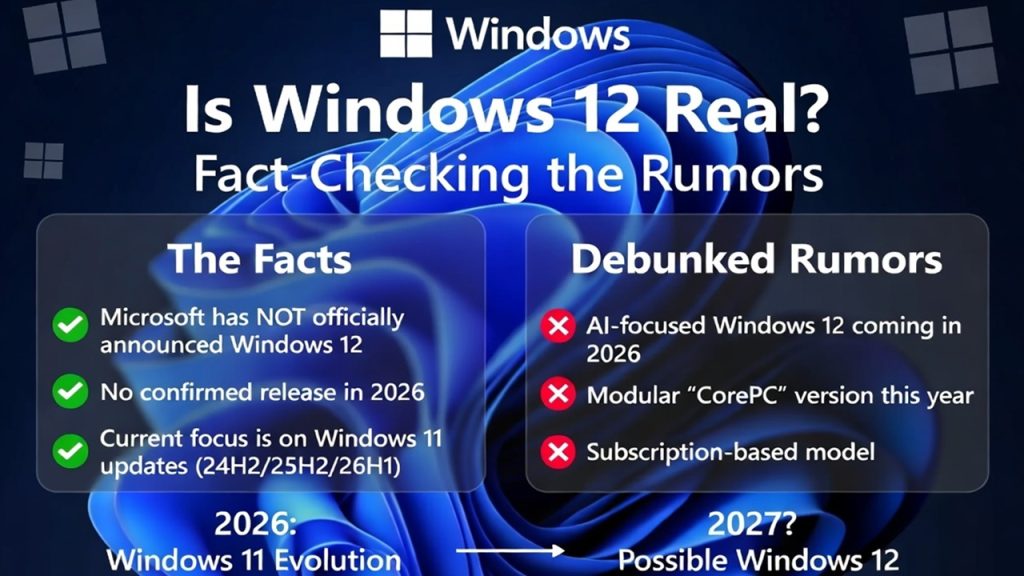
Windows 12 is a real name Microsoft has used informally in its own long-term product roadmaps, but it is not a released product, a confirmed upcoming release, or something you can currently install in any form. Most of what you’ve seen calling itself “Windows 12,” whether that’s a screenshot, a countdown timer, an ISO file, or a YouTube “leaked build” video, is either a concept design mistaken for a leak, outdated speculation, or content built specifically to get clicks from people searching this exact question.
Here’s how to tell the difference, claim by claim.
Claim: “Windows 12 has been officially confirmed”
Partially true, badly framed. Microsoft has acknowledged working on future Windows development internally, and the name “Windows 12” has surfaced in reporting sourced from people close to the company. What Microsoft has not done is confirm a release date, a feature list, or even that the next major version will carry the “12” name at all. In May 2026, Pavan Davuluri, who leads Windows and Surface at Microsoft, directly addressed speculation that had been building ahead of Build 2026 by stating that upcoming announcements would not include a new operating system version. That’s about as clear a signal as you’ll get from Microsoft itself, and it flatly contradicts headlines claiming a confirmed launch.
Claim: “There’s a leaked Windows 12 ISO you can download”
False, and worth taking seriously as a warning rather than just a rumor. There is no official Windows 12 installation media, which means any file being distributed under that name cannot be verified against a real Microsoft source. Microsoft’s own community forums have warned users directly that people advertising a Windows 12 ISO as available are typically attempting to access personal information, payment details, or a user’s system rather than distributing real software. If you’ve seen a page describing a specific file name or file size for a “Windows 12 ISO,” that’s a fabricated detail meant to look credible, not a real product spec. We cover this in more depth, including what to download safely instead, in our guide to the Windows 12 ISO situation.
Claim: “Leaked screenshots show the new Windows 12 interface”
Mostly false. A huge share of the “leaked Windows 12” images circulating online are concept renders made by designers and enthusiasts, not screenshots from an actual Microsoft build. Some of these are labeled as concepts by their original creators and then get re-shared without that context, at which point they start looking like genuine leaks to anyone who didn’t see the original source. A few images have come from legitimate early Windows 11 Insider builds testing new visual elements, like floating taskbar experiments or updated File Explorer designs, which then get mislabeled as “Windows 12” by sites trying to capitalize on the search volume rather than being accurate about what they’re actually showing.
Claim: “Windows 12 will require new hardware, and your PC won’t be compatible”
Unconfirmed and premature. Nobody outside Microsoft knows the hardware requirements for a product that hasn’t been announced. Some coverage has speculated about deeper NPU (AI processor) requirements building on Microsoft’s existing Copilot+ PC standard, which does require specific NPU performance thresholds. That’s a reasonable guess based on where Microsoft has already been pushing Windows 11, but it is not a confirmed requirement for a future release, and pages stating specific hardware specs as fact are presenting speculation as certainty.
Claim: “Windows 12 was already shown at CES or Build”
False, and this one has a clear paper trail. Ahead of Build 2026, Microsoft’s Windows account, along with NVIDIA and Arm, posted teasers referencing “a new era of PC,” which fueled a wave of Windows 12 announcement predictions. What actually got announced was hardware and silicon news, specifically tied to NVIDIA’s Jensen Huang and an Arm-based chip project with MediaTek, not a new Windows version. Windows 12 similarly did not appear at CES. Anyone claiming otherwise is either confused about what was actually shown or deliberately misrepresenting a hardware announcement as an OS launch.
Why do these rumors keep circulating?
A few real dynamics keep this cycle going, and understanding them helps explain why the rumor mill doesn’t just stop:
Search demand creates its own incentive. People have been searching “Windows 12” for years, which means there’s a standing audience for anything published under that name, whether or not there’s real news to report. That incentive exists independent of whether Microsoft has actually done anything.
Historical naming patterns fuel expectation. Microsoft skipped “Windows 9” entirely, jumping from 8.1 straight to Windows 10, and windows version numbering has never followed a strict predictable pattern. That history makes it easy for any plausible-sounding leak to gain traction, since past naming decisions genuinely were unpredictable.
Concept design communities blur the line. Designers regularly publish “what Windows 12 could look like” concept work, which is legitimate creative speculation, but it circulates on social media stripped of context until it’s indistinguishable from an actual leak to someone scrolling quickly.
AI-generated content farms compound the problem. A significant number of “Windows 12 confirmed” articles are templated content built to rank for the keyword rather than to report anything new, recycling the same unconfirmed claims from each other in a loop, which makes a rumor look more credible simply because it appears on multiple sites, regardless of whether any of them actually verified it.
How to tell a real Windows leak from a fake one
If you want to evaluate future claims yourself rather than relying on any single source, including this one, here’s a practical checklist:
Check the source chain. Reliable Windows reporting (Windows Central, The Verge, Neowin, Tom’s Hardware) typically cites either an on-the-record Microsoft statement, a verified Windows Insider build, or a named source with a track record. If a claim only cites “sources say” with no further detail, or only cites other blogs making the same claim, treat it with real skepticism.
Look for a verifiable build number. Actual Windows Insider builds ship with specific build numbers that get documented on Microsoft’s own Windows Insider Blog. A real leak usually includes this kind of specific, checkable detail. A page describing “Windows 12” in general terms without a build number is more likely describing a concept or a rumor.
Be suspicious of invented specificity. Fake leaks often include oddly precise details, like an exact file size or install time, specifically because specificity is what makes fabricated content feel credible. Real early leaks tend to be messier and less complete, not polished with exact figures.
Check the date. A lot of recycled Windows 12 content gets republished with an updated “last modified” date while the actual content underneath stays the same stale prediction. Read the body of the article, not just the date stamp, to see if anything has actually changed since the last version.
Cross-check against Microsoft’s own channels. The Windows Blog and Windows Insider Blog are Microsoft’s actual first-party channels. If something huge like a new OS version were genuinely imminent, it would show up there first, not exclusively on a third-party blog.
What’s the honest bottom line?
Windows 12 is very likely something Microsoft is thinking about long-term, given how software companies typically plan multiple years ahead, and given that internal roadmap references to the name have surfaced in reporting. But as of today, it is not an announced product, has no confirmed release date, and has no legitimate installation media anywhere. Everything currently claiming otherwise, particularly anything offering a download, should be treated as unverified at best and actively unsafe at worst. For the most current status and a full timeline of what Microsoft has and hasn’t said, see our Windows 12 release date tracker, which we update as real developments happen rather than recycling old predictions.
Frequently asked questions
Is Windows 12 a confirmed Microsoft product? No. The name has appeared in reporting and roadmap speculation, but Microsoft has not confirmed a release, a feature set, or a date, and has directly stated that near-term announcements do not include a new OS version.
Are the Windows 12 screenshots online real? Most circulating images are concept designs made by third-party designers, not actual screenshots from a Microsoft build. Some genuine Windows 11 Insider test features have also been mislabeled as Windows 12.
Is there a real Windows 12 ISO file? No. There is no official installation media for Windows 12. Any file distributed under that name should be treated as unverifiable and potentially unsafe.
Why do so many sites say Windows 12 is confirmed? Search demand for the term creates an incentive to publish content under that name regardless of whether there’s actual news, and a lot of that content recycles unverified claims from other similar sites rather than sourcing anything new.
How can I get real updates when Windows 12 actually happens? Follow Microsoft’s official Windows Blog and Windows Insider Blog directly, and check sources that cite verifiable build numbers or on-the-record Microsoft statements rather than anonymous “sources say” claims.