There isn’t one. Not yet, anyway.
If you’ve spent any time searching for “Windows 12 release date,” you’ve probably noticed the same handful of guesses getting recycled across dozens of sites: late 2025, early 2026, “sometime this year.” Most of that content was written before Microsoft actually addressed the question directly. This page tracks what’s confirmed, what’s still speculation, and what changed most recently, and we’ll keep updating it as the story develops rather than leaving stale predictions sitting at the top of the page.
The short version
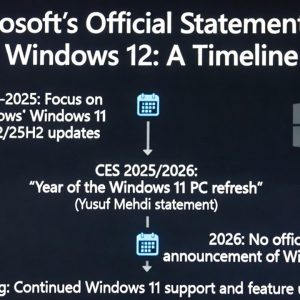
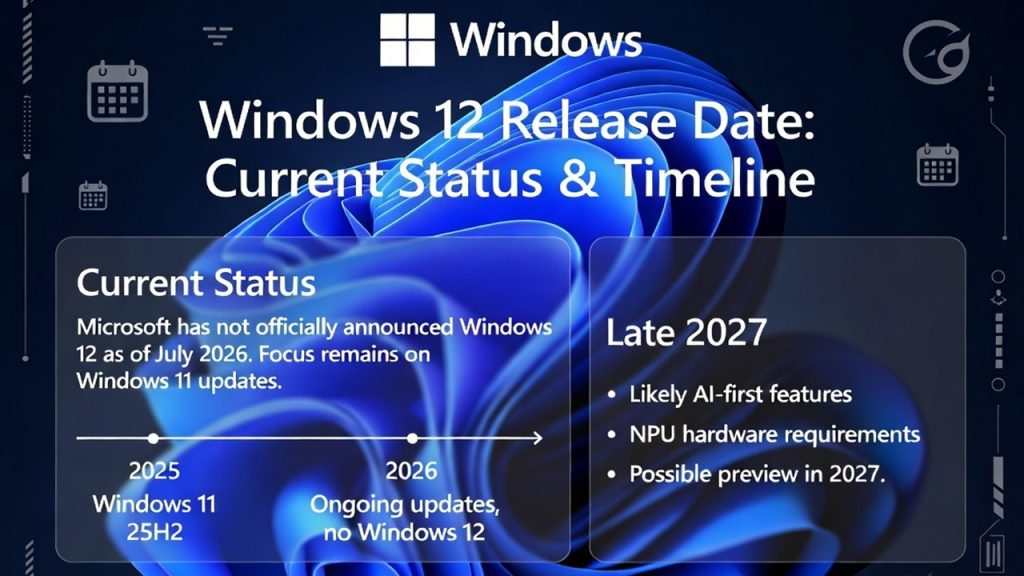
Microsoft has not announced Windows 12, has not confirmed a release date, and as of the most recent public comments from Microsoft’s own leadership, is not planning to launch a new operating system version in the near term. Windows 11 remains the current, actively developed platform, with feature updates rolling out under versions like 25H2 and 26H1.
That’s not the same as saying Windows 12 is cancelled. It means nobody outside Microsoft actually knows if or when it’s coming, and most of what circulates online is extrapolation dressed up as insider knowledge.
What actually happened in May 2026
This is worth walking through in detail, because it’s the single most important update in this whole saga and a lot of competing pages either missed it or buried it under old speculation.
In the days leading up to Microsoft’s Build 2026 developer conference, tech coverage was full of buzz that Microsoft would finally unveil Windows 12. Part of what fueled this was a coordinated social media tease: Microsoft’s Windows account, along with NVIDIA and Arm’s official accounts, all posted some version of the phrase “a new era of PC” around the same time, followed later by MediaTek. Naturally, people connected the dots to a new Windows version.
Pavan Davuluri, who currently leads both the Windows and Surface divisions at Microsoft, stepped in to head off that expectation. He confirmed directly that the upcoming announcements would not include a new operating system version. The tease was actually tied to hardware news, specifically NVIDIA CEO Jensen Huang’s Computex keynote in Taipei and an Arm-based silicon project (codenamed N1X) being developed with MediaTek, not a Windows 12 launch.
So the honest takeaway from Build 2026 is this: Microsoft used the moment to reinforce that it’s still investing in Windows 11, not to introduce its successor.
Why people keep expecting Windows 12 anyway
The expectation isn’t irrational. A few real signals feed it:
The historical release cadence. Windows 7 arrived roughly three years after Vista. Windows 11 launched in October 2021, about six years after Windows 10. If Microsoft returns to a shorter three-year cycle, that would put a new release around 2024 to 2025, a window that’s already passed. If the six-year pattern holds instead, that points closer to 2027.
Windows 11’s support runway. Windows 11 25H2 is scheduled to receive updates through October 2027. That kind of long support window has, in the past, lined up with the runway before a new OS generation, which is part of why some outlets peg 2027 as the more realistic target than 2026.
The AI hardware push. Microsoft has spent the last two years building Copilot, Copilot+ PCs, and NPU-based features directly into Windows 11 rather than holding them back for a future release. Some industry watchers read this as evidence that Microsoft plans to keep evolving Windows 11 rather than fragmenting its user base with a new version name, at least in the near term.
Windows 10’s end of support. Windows 10 officially stopped receiving support in October 2025, which pushed a large share of remaining Windows 10 users to migrate to Windows 11 rather than wait around for an unannounced successor. That migration wave is arguably more useful to Microsoft right now than launching something new that could split its install base again.
None of this confirms a date. It just explains why the guesswork keeps circulating.
Is Windows 11 26H1 secretly Windows 12?
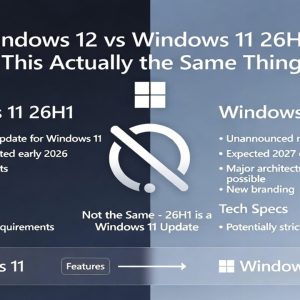
No, and this is worth addressing directly because it’s a genuinely common point of confusion. Windows 11 version 26H1 is listed by Microsoft as available starting February 10, 2026, but it’s scoped specifically to support new devices coming to market in early 2026. It is not a broad feature update for existing Windows 11 24H2 or 25H2 devices, and it is not a rebrand of Windows 11 into a new major version. If you’re running Windows 11 today, 26H1 is not the “Windows 12” you may have heard about.
What credible outlets are currently predicting
Setting aside the sites that invent specific dates to look authoritative, the more grounded reporting lands in a narrower range:
Windows Central’s reporting has suggested Microsoft has no plan to bring a new Windows version to market in 2026, with the company’s roadmap for the year focused on stabilizing and improving Windows 11’s reputation instead. Some coverage citing industry analysts places a realistic window in the second half of 2027, reasoning partly from the six-year gap between Windows 10 and Windows 11.
Other outlets have floated a codename (“Hudson Valley” or a variant of it) and described deep AI integration as a defining feature of whatever comes next, alongside a more modular “CorePC” style architecture that would let Microsoft update system components like security or AI features independently rather than through full OS-wide updates.
Treat all of this as informed speculation, not confirmation. Codenames and modular architecture concepts have appeared in leaks before without ever becoming an official product on the timeline people expected.
What this means if you’re deciding whether to wait
If you’re holding off on a new PC or an OS upgrade because you’re expecting Windows 12 any moment, here’s the practical reality: there’s no confirmed upgrade path, no confirmed hardware requirement, and no confirmed date. Microsoft has explicitly said the near-term roadmap does not include a new OS version.
For most people, the sensible move is to keep Windows 11 updated, since Microsoft has committed to supporting it for years to come, and revisit the decision once (or if) an actual announcement happens. If you’re still on Windows 10, upgrading to Windows 11 now is the safer path rather than waiting on an unconfirmed successor. For details on what a real Windows 12 download would look like if and when it happens, and why the “ISO downloads” currently circulating aren’t legitimate, see our Windows 12 ISO Download guide.
A quick myth check
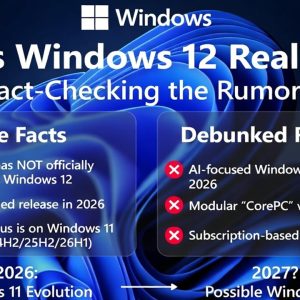
Because a lot of search traffic around this topic comes from people who aren’t sure if Windows 12 is real at all, it’s worth stating plainly: Windows 12 is not confirmed as a product name, is not in public beta, and has no Insider Preview builds available. For a deeper breakdown of the specific claims circulating and why they don’t hold up, see Is Windows 12 Real? Fact-Checking the Rumors.
Frequently asked questions
Has Microsoft confirmed Windows 12? No. Microsoft has not confirmed Windows 12 as a product name, feature set, or release date. The company’s Windows and Surface lead has directly stated that upcoming announcements would not include a new OS version.
What year will Windows 12 be released? There’s no confirmed year. Speculation based on Microsoft’s historical release cadence and current Windows 11 support timeline points to 2027 as more likely than 2026, but this is an estimate, not an official date.
Is Windows 11 26H1 the same as Windows 12? No. Windows 11 26H1 is a scoped update for new devices launching in early 2026, not a new major OS version or a rebrand.
Should I wait for Windows 12 before buying a new PC? Given there’s no confirmed release date, waiting indefinitely isn’t practical for most people. If you need a PC now, buying one that runs Windows 11 well is the safer choice.
Where can I get real updates on Windows 12 as they happen? Follow Microsoft’s official Windows Blog and Windows Insider Program, and check back here, since we update this page directly when there’s an actual development rather than recycling old speculation.