There’s an ironic twist to this comparison. While “Windows 12” remains an unconfirmed rumor with no release date, Google has already confirmed, on the record, that ChromeOS itself is going away, merging into Android under a new unified platform internally called Aluminium OS. So the more accurate framing here isn’t Windows 12 versus ChromeOS as two upcoming products. It’s a genuinely confirmed platform shift on Google’s side against a genuinely unconfirmed one on Microsoft’s, and that distinction matters a lot for anyone trying to plan around either.
What Google has actually confirmed
At Qualcomm’s Snapdragon Summit in September 2025, Google’s president of the Android ecosystem, Sameer Samat, stated directly that the company is combining ChromeOS and Android into a single platform, rebuilding ChromeOS’s experience on top of Android’s underlying technology rather than maintaining two separate operating systems. This wasn’t speculation or a leak, it was an on-the-record statement from a named Google executive at a public event, later reinforced in a TechRadar interview where Samat repeated the plan explicitly.
Google has framed the motivation primarily around AI, wanting to bring the pace of Android’s AI development to laptop-form-factor devices more quickly than maintaining ChromeOS separately would allow, while also unifying the developer experience across phones, tablets, and laptops. Reporting has also connected this partly to broader antitrust pressure Google is facing over its Chrome browser, though Google’s own public statements focus on the AI and ecosystem-unification rationale.
Existing Chromebooks aren’t being abandoned overnight. Google has committed to a full 10 years of software updates for existing ChromeOS devices, and the transition is expected to run in parallel for some time rather than as an abrupt cutover. Internal testing has reportedly involved multiple hardware tiers, suggesting Google intends to support everything from budget Chromebooks to higher-end devices under the new platform, though as of mid-2026 the exact rollout timeline (full public release potentially landing closer to 2027 or 2028 according to court filings) remains somewhat unsettled.
Why this comparison keeps coming up at all
Search interest connecting Windows 12 to ChromeOS mostly stems from Windows’s own long-running modular architecture rumors, generally referred to as CorePC or Core OS. The idea, separating Windows into isolated, independently updatable components, would move Windows conceptually closer to how ChromeOS has always worked: lightweight, fast-booting, easier to reset or repair without disrupting the whole system. If Microsoft ever ships something like this, “a lightweight Windows that behaves more like ChromeOS” would be a fair way to describe it.
The catch is that CorePC has never shipped publicly, despite years of leaks and internal references tracing back to the shelved Windows Core OS and Windows 10X projects. There’s no confirmed evidence it’s part of Microsoft’s near-term plans, even though the concept keeps resurfacing. For the full breakdown of where CorePC actually stands as a concept versus a shipping reality, see our detailed look in Windows 12 Features: What’s Rumored, Confirmed, and Already in Windows 11.
Side by side: confirmed versus rumored
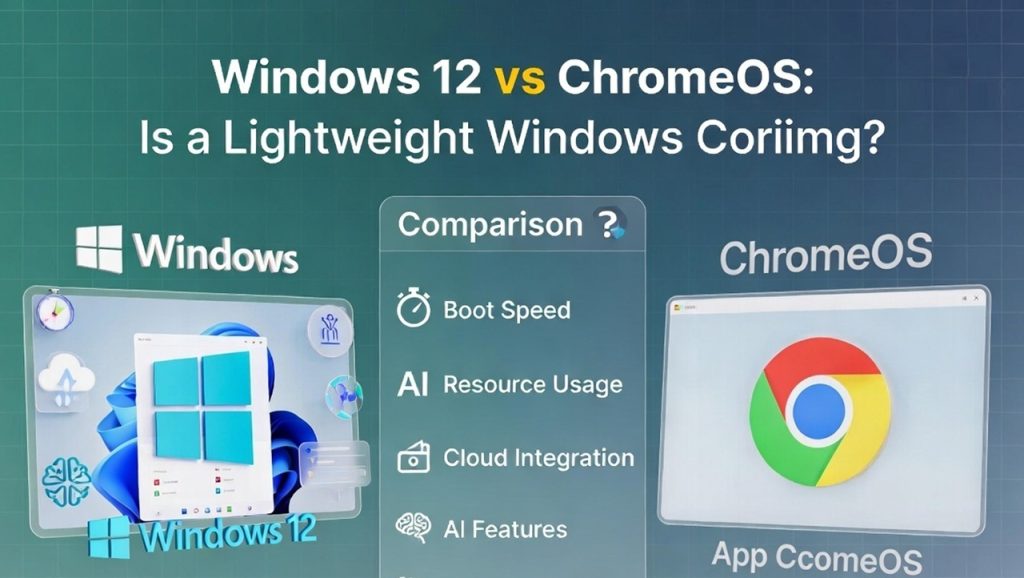
| ChromeOS → Aluminium OS | Windows 11 → rumored “lightweight Windows 12” | |
|---|---|---|
| Officially confirmed | Yes, by named Google executive on the record | No, CorePC remains unconfirmed speculation |
| Stated motivation | Faster AI development pace, unified ecosystem | Speculated modular updates, faster resets |
| Underlying technology | Rebuilding ChromeOS on Android’s foundation | Traditional monolithic architecture, unchanged |
| Existing device support | 10 years of updates committed for current Chromebooks | N/A, no confirmed transition exists |
| Public timeline | Testing during 2026, broader rollout possibly 2027 to 2028 | No confirmed date; broader Windows 12 speculation points to 2027 at earliest |
What this means if you’re choosing between the two ecosystems today
If lightweight, fast-booting, low-maintenance computing is what’s actually drawing you to consider ChromeOS, that’s a real, currently available option today, not a future promise. Current Chromebooks already deliver that experience, and Google’s own 10-year update commitment means an existing device isn’t going to be orphaned by this transition anytime soon.
If you’re specifically waiting to see whether Windows becomes similarly lightweight through a rumored Windows 12, that’s a much less certain bet. Windows 11 today runs on the same traditional architecture it always has, and while Microsoft has clearly been improving performance (recent updates have added things like a Low Latency CPU profile for faster app launches), that’s optimization within the existing architecture, not the modular rebuild that CorePC speculation describes.
Could Windows actually end up looking more like ChromeOS?
It’s a reasonable question given how much overlap exists between the CorePC concept and what ChromeOS has always represented: a simpler, more contained, easier-to-manage system. If Microsoft ever does ship a modular Windows architecture, the practical result really would move Windows conceptually closer to ChromeOS’s model, at least in terms of update behavior and system resilience. But there’s a meaningful difference between a plausible, well-reasoned prediction and a confirmed roadmap item, and right now CorePC sits firmly in the former category. Google’s Aluminium OS, by contrast, has cleared that bar with an on-record executive statement and a concrete (if still shifting) public timeline.
For the fullest, continuously updated picture of where any next-generation Windows release actually stands, check our Windows 12 release date and status tracker. And if you’re weighing hardware decisions based on where Windows might be headed architecturally, our breakdown in Windows 12 System Requirements: What We Can Predict from Windows 11 covers the reasoning in more depth.
The AI angle connects both stories
Both Google’s Aluminium OS push and the speculation around a next-generation Windows are ultimately motivated by the same underlying pressure: getting AI features to users faster and more deeply embedded in the OS itself. Google’s stated goal is accelerating Gemini’s presence across device categories by unifying its platforms. Microsoft’s Copilot+ PC strategy reflects a similar ambition, just executed without a full architectural rebuild so far. If there’s one throughline connecting ChromeOS’s confirmed transformation and Windows’s speculative one, it’s that both major platform holders see their current architecture as a constraint on how fast they can ship AI capability, and both are responding, just on very different confirmed-versus-rumored footing. For more on how Windows 11’s AI direction compares against competitors more broadly, see Windows 12 vs macOS: What Rumored AI Features Would Actually Change.
Practical takeaway
Don’t hold off on a purchase decision waiting for “lightweight Windows 12” to arrive and match ChromeOS, since there’s no confirmed timeline or feature set behind that idea at all. If lightweight, low-maintenance computing is genuinely what you need today, a current Chromebook (with its now-confirmed decade of committed updates) is the more reliable choice. If you’re specifically invested in the Windows ecosystem for software compatibility or existing habits, current Windows 11 remains a mature, actively improving platform, and any architectural shift toward something ChromeOS-like remains speculative rather than something to actively wait for.
Questions people tend to ask here
Is ChromeOS actually being discontinued? Not immediately. It’s being merged into a new unified platform (Aluminium OS) built on Android’s foundation, with existing Chromebooks receiving a full 10 years of updates as the transition happens gradually.
Is Windows 12 going to be a lightweight, ChromeOS-style operating system? Unconfirmed. There’s a long-running rumor (CorePC) about a modular Windows architecture, but it has never shipped and isn’t confirmed as part of Microsoft’s near-term plans.
Which is more certain: Aluminium OS or a lightweight Windows 12? Aluminium OS, by a wide margin. It’s been confirmed on the record by a named Google executive with a stated (if still shifting) timeline, while any lightweight Windows architecture remains speculative.
Should I switch to a Chromebook now if I want simpler, low-maintenance computing? If that’s your priority today, yes, that’s a real, available option, rather than something to wait on Microsoft for.